
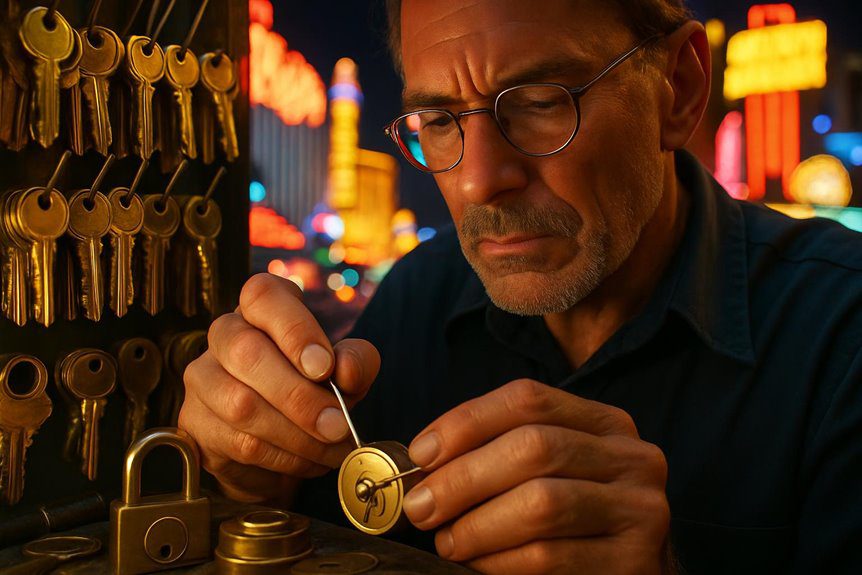
Locksmith Buyer’s Guide
7 Best Locksmith Services in Las Vegas for Home, Car, and Business Needs in 2026
Editorial disclosure: Silver Eagle Locksmith provides the services discussed in this company-produced educational guide. Recommendations are based on problem fit, urgency, compatibility, security value, limitations and pricing transparency.
Quick answer
The best locksmith service depends on the problem. Choose emergency lockout help when access is blocked; automotive service for car keys, transponders and fobs; rekeying when old keys should stop working; repair or replacement for damaged hardware; commercial service for business access management; smart-lock installation for keyless entry; and high-security upgrades when physical resistance and controlled key duplication are the priorities.
Getting locked out may be the most urgent reason to contact a locksmith, but it is not the only one. Homeowners may need locks rekeyed after moving. Drivers may need a transponder key made at their vehicle. Businesses may need to remove a former employee’s access, and property managers may need master-key or controlled-key systems.
The right service depends on what must be accessed or secured, whether a working key remains, the condition of the hardware, urgency, compatibility and whether the goal is convenience, restored access or better security.
Best Las Vegas locksmith services at a glance
| Service | Best for | Strength | Limitation | Pricing factors |
|---|---|---|---|---|
| Emergency lockout | Blocked access | Restores access | Damage or malfunction may require more work | Time, location, lock and condition |
| Automotive | Keys, fobs and vehicle lockouts | Mobile cutting/programming may be available | Vehicle support varies | Vehicle, key type, parts and programming |
| Rekeying | New owners and missing keys | Disables previous keys | Does not fix damaged hardware | Cylinder count and compatibility |
| Repair/replacement | Broken or worn locks | Restores operation or upgrades security | Door or frame may also need work | Hardware, damage and labor |
| Commercial | Businesses and managed properties | Supports access levels and key control | Complex systems need planning | Door count, hardware and system design |
| Smart locks | Keyless access | Codes, apps and credentials | Compatibility and maintenance vary | Product, installation and setup |
| High security | Physical resistance and key control | Stronger, controlled systems | Higher initial cost | Certification, reinforcement and scale |
How we evaluated the services
Criteria
- Problem fit: Does the service solve the customer’s actual issue?
- Urgency: Is immediate access required, or can the work be planned?
- Security value: Does the service merely restore access or improve long-term security?
- Compatibility: Will the lock, key, vehicle, door or platform support the work?
- Pricing transparency: Can dispatch, labor, hardware and programming variables be explained?
- Limitations: When would another service be more appropriate?
The City of Las Vegas locksmith checklist includes identification requirements for locksmith vehicles, technicians and applicable locations. Customers can use those requirements as part of their verification process. See the City of Las Vegas Locksmith Checklist.
1. Emergency lockout assistance
Best for: People unable to access a home, apartment, vehicle, office or commercial property.
A locksmith should identify the lock, verify authorization and determine an appropriate opening method. The goal is to restore access with as little unnecessary damage as practical, although damage-free entry cannot be guaranteed when a lock is broken, previously damaged or malfunctioning internally.
Common uses
- House, apartment, office and storefront lockouts
- Vehicle lockouts
- Keys locked inside
- Broken-key extraction
- Jammed locks and latches
- Electronic locks that are not responding
- Doors blocked by alignment or hardware problems
Typical service process
- Describe the location, lock and problem.
- Request the service-call charge and preliminary estimate.
- Prepare identification or proof of authorization.
- Have the technician assess the lock and proposed method.
- Approve the final scope and price before work begins.
- Test the completed work and obtain an itemized invoice.
When another service may be needed
Consider rekeying, repair or replacement if a key was stolen, an old occupant may retain access, the lock is worn, the door is misaligned or the hardware was damaged during attempted entry.
2. Automotive locksmith and car-key service
Best for: Vehicle lockouts, lost keys, spare keys, transponder programming, fob replacement and broken keys.
Modern vehicle keys may combine a mechanical blade, transponder, remote and proximity credential. A mobile automotive locksmith may be able to cut and program a replacement at the vehicle, but support varies by year, make, model and security system.
Services may include
- Vehicle opening
- Mechanical key cutting
- Transponder programming
- Remote-head and proximity keys
- Duplicate keys
- All-keys-lost service
- Broken-key extraction
- Fob battery and function testing
Information to provide
- Year, make, model and trim
- Vehicle location and VIN, if available
- Whether a working key remains
- Key or fob type
- Symptoms and proof of ownership or authorization
Locksmith or dealership?
A mobile locksmith may be preferable when the vehicle cannot be driven and the key is supported. A dealership may be required for manufacturer-restricted systems, warranty work or vehicle-security faults beyond the key. Compare complete costs, including programming and any towing.
3. Residential lock rekeying
Best for: New homeowners, tenant turnover, missing keys and access changes.
Rekeying changes a compatible lock’s internal keying so the old key stops working while the existing exterior hardware remains. It is often appropriate after buying a home, losing an identifiable key, changing tenants or recovering an uncertain number of key copies.
Choose rekeying when
- The hardware works correctly
- The main concern is old or unauthorized keys
- You are satisfied with the current lock
- Compatible locks should operate with one new key
Choose replacement instead when
- The lock is damaged, corroded or unreliable
- The hardware is obsolete or unsuitable
- You want a new function, finish or security level
- You are moving to a smart or high-security system
Rekeying does not repair a weak frame, loose hinges, poor strike attachment, deadbolt misalignment, failing latch or damaged door.
4. Lock repair and replacement
Best for: Broken, worn, misaligned, outdated or unreliable locks.
A difficult lock does not automatically need replacement. The cause may be alignment, a worn component, improper installation, corrosion, a damaged key or movement in the door and frame.
Warning signs
- The key is hard to insert, remove or turn
- The deadbolt does not extend fully
- The latch fails to catch
- The cylinder, handle or lock is loose
- The key works only when lifted or angled
- The door must be pushed or pulled hard to lock
- The hardware has forced-entry damage
Repair versus replacement
Repair may be sensible when suitable hardware can be adjusted or serviced reliably. Replacement may be better when parts are obsolete, the lock is badly damaged, the product no longer fits the use case or an upgrade is needed.
Evaluate the complete opening: lock, door, frame, strike, fasteners, hinges and nearby material. Recognized testing is more informative than unsupported marketing labels; see the ANSI/BHMA standards overview.
5. Commercial locksmith service
Best for: Offices, stores, restaurants, warehouses, medical practices, multifamily properties and other managed facilities.
Commercial locksmith work may involve multiple doors, changing employees, restricted rooms, emergency exits and several access levels. The goal is to let authorized users enter the correct areas without creating unnecessary access elsewhere.
Commercial services may include
- Commercial lockouts, rekeying and lock replacement
- Employee and tenant access changes
- Master-key and grand master-key systems
- Interchangeable-core locks
- Restricted-key and controlled-key systems
- Commercial deadbolts, lever sets and storefront locks
- Panic hardware, exit hardware and door closers
- Keypads and compatible electronic access hardware
- Key-control planning and hardware maintenance
How master-key systems work
A master-key system can assign different access levels to different users. For example, an employee key may open one room, a department key may open several related areas, and a management key may open most or all locks in the system.
The system should be documented carefully. Issuing too many high-level keys reduces its security value.
When to rekey a business
- After an employee or tenant leaves
- When a key is lost or not returned
- After temporary contractor access
- Following a break-in or attempted break-in
- After acquiring or taking over a facility
- When undocumented keys are discovered
- When room use or access privileges change
Questions to ask about restricted-key systems
- Who can authorize duplicate keys?
- What documentation is required?
- Where can copies be produced?
- How long will the system be supported?
- What happens when a key is lost?
- Can the system expand with the business?
- Are replacement keys and cylinders readily available?
Important commercial limitation
Fire doors, panic hardware and emergency exits may be subject to building, fire, accessibility and life-safety requirements. Confirm that the provider is qualified for the proposed work and determine whether permits, inspections or other contractors are required. Never modify an exit in a way that improperly restricts emergency egress.
6. Smart-lock installation
Best for: Homeowners, rental operators, property managers and businesses that want keyless entry or easier access administration.
Smart locks may support keypads, apps, fingerprints, cards, fobs, remote access or physical backup keys. Useful features depend on the property, the users and how reliably the system will be maintained.
Features to compare
- Keypad, app, biometric, card or fob access
- Temporary and scheduled codes
- Access history and notifications
- Automatic locking
- Remote locking and unlocking
- Wi-Fi, Bluetooth, Thread, Z-Wave or Zigbee support
- Matter and smart-home platform compatibility
- Physical key override or emergency power
- Battery alerts and expected battery life
- Weather resistance
- User limits, subscriptions and software-support policy
Compatibility checklist
- Door thickness and backset
- Bore-hole dimensions and existing preparation
- Door handing and interior clearance
- Deadbolt and strike alignment
- Weather exposure
- Nearby trim or glass
- Lease, business or association restrictions
- Required network or smart-home platform
A motorized deadbolt may fail when the bolt rubs against the strike or requires force to extend. Correct door alignment should be addressed before relying on electronic operation.
Security and maintenance limits
A smart lock is not automatically more secure than a mechanical lock. Overall security also depends on the lock’s construction, strike attachment, door and frame, installation, user codes, account protection, updates, batteries and network security.
Choose smart-lock installation when
- You want keyless entry or temporary codes
- You regularly grant and revoke access
- The product fits the door and intended platform
- Someone will maintain batteries, software and user accounts
- A backup-access procedure has been established
7. High-security lock and door upgrades
Best for: Properties needing stronger hardware, improved key control or greater resistance to physical attack.
“High security” should refer to meaningful product features, recognized testing, correct installation and a solution appropriate to the property—not merely an advertising label.
A security upgrade may include
- Stronger deadbolts and commercial-grade hardware
- Reinforced strikes and appropriate fasteners
- High-security cylinders
- Restricted-key systems
- Drill-resistant or manipulation-resistant components
- Door and frame reinforcement
- Interchangeable-core systems
- Documented key issuance and authorization procedures
Physical resistance versus key control
| Physical resistance | Key control |
|---|---|
| Resistance to drilling and forced rotation | Who can authorize duplicate keys |
| Stronger door, frame and strike attachment | Where duplicate keys can be produced |
| Resistance to prying, impact or manipulation | How issued keys are documented |
| Correctly fitted and installed hardware | What happens when a key is lost |
After a break-in
When appropriate, contact law enforcement and avoid disturbing evidence. Once the property can be secured, assess the point of entry, lock, cylinder, door, frame, strike, hinges, nearby glass, secondary doors and any stolen keys or credentials.
If keys were taken, changing the keying or access credentials may be necessary even if the locks were not physically damaged.
Choose a high-security upgrade when
- Basic hardware no longer meets the risk level
- Unauthorized key duplication is a concern
- The property has experienced forced entry
- Sensitive or restricted areas require controlled access
- You are prepared to evaluate the entire door opening
Decision framework: which locksmith service should you choose?
| If this is your situation | Start with this service |
|---|---|
| You cannot enter a home, vehicle or business | Emergency lockout assistance |
| You lost a vehicle key, fob or transponder | Automotive locksmith service |
| Old keys should stop working, but the locks are suitable | Rekeying |
| The lock is damaged, worn or unreliable | Repair or replacement |
| Several business users need different access levels | Commercial locksmith service |
| You want codes, apps or electronic credentials | Smart-lock installation |
| You need stronger hardware and tighter key control | High-security assessment |
Avoid choosing by price alone
A very low advertised starting price may exclude dispatch, labor, hardware, programming or after-hours conditions. Compare the complete scope, authorization procedure, warranty and final estimated total.
How to hire a Las Vegas locksmith safely
A lockout creates urgency, but customers should still verify the company, technician, scope and price. The Federal Trade Commission has warned consumers about locksmith advertisements that may route calls to providers who quote one amount and demand substantially more at the job.
- Confirm the company name. Ask the dispatcher for the full operating or legal business name.
- Ask who is being dispatched. Determine whether the technician is an employee or subcontractor and which company will issue the invoice.
- Request an estimate. Ask about dispatch, labor, hardware, programming, after-hours conditions and cancellation charges.
- Verify the arrival. Confirm that the technician and vehicle identify the company you contacted.
- Expect an authorization check. A locksmith should make a reasonable effort to verify that you may access the property or vehicle.
- Approve changes first. If inspection changes the scope, request the revised total before additional work begins.
- Question unexplained drilling. Ask why drilling is necessary, what will be damaged and what replacement will be installed.
- Request an itemized invoice. It should identify the business and describe labor, parts and other charges.
- Test the work. Test every key, lock, code, button or credential before the technician leaves.
Potential warning signs
- The dispatcher refuses to identify the company
- The business will not explain its service-call charge
- The arriving company differs from the company called
- The technician will not provide or update an estimate
- Drilling is proposed before the lock is meaningfully assessed
- The price changes substantially without an explanation
- No itemized invoice is provided
Read the FTC locksmith consumer warning and the City of Las Vegas locksmith checklist.
What affects locksmith pricing in Las Vegas?
There is no universal price for every locksmith job. An accurate estimate depends on the actual lock, vehicle, hardware, timing and required work.
Common pricing factors
- Service-call charge: The cost of dispatching a technician.
- Scheduling: Planned daytime work may differ from urgent, late-night, weekend or holiday service.
- Lock type: Residential cylinders, commercial mortise locks, electronic locks and vehicle systems require different work.
- Labor: Adjustment, disassembly, key extraction, key generation and programming vary in complexity.
- Parts: Hardware prices vary by brand, grade, function, finish and technology.
- Quantity: One rekey is different from an entire house or commercial system.
- Vehicle technology: Year, model, key type, programming method and whether a working key remains all matter.
- Door condition: Misalignment, damage or incompatible preparation can increase the work required.
Questions to ask when comparing quotes
- Is the dispatch charge included?
- What labor is included?
- Are hardware, keys or programming included?
- What could change the estimate?
- Are taxes or other fees additional?
- What warranty applies?
- Will the revised total be approved before extra work?
What to prepare before calling
For a home or business
- Complete service address
- Property and door type
- Photos of the lock and door
- Whether any key remains
- Whether the key is lost, stolen or broken
- Number of locks involved
- Known damage or alignment problems
- Desired result: entry, repair, rekeying or replacement
For a vehicle
- Year, make, model and trim
- VIN, if available
- Vehicle location
- Key or fob type
- Whether a working key remains
- Description of the symptoms
- Proof of ownership or authorization
For a commercial project
- Number and types of doors
- Current hardware and key system
- Number of users and required access levels
- Key-control concerns
- Any fire doors or exits involved
- Existing master-key records
- Plans for future expansion
Why choose Silver Eagle Locksmith?
Silver Eagle Locksmith provides residential, automotive and commercial locksmith services for Las Vegas, Henderson and North Las Vegas. Advertised services include lockout assistance, lock rekeying, repair and replacement, car-key cutting and programming, commercial locksmith work, master-key systems, smart locks and high-security hardware.
Service availability, vehicle coverage, scheduling and pricing depend on the location and job requirements. Describe the problem completely when requesting an estimate so the team can identify likely parts, equipment and compatibility requirements.
Request locksmith service
Call (702) 539-9581 to discuss your home, vehicle or business locksmith needs in the Las Vegas area.
Frequently asked questions
What is the best locksmith service for a new homeowner?
Rekeying is generally appropriate when the existing locks function properly but you do not know who has old keys. Replace locks that are damaged, unreliable, obsolete or below the desired security level.
Is it cheaper to rekey or replace a lock?
Rekeying often requires fewer new parts, but replacement may offer better value when the hardware is damaged, worn or unsuitable. Ask for both options when either could solve the problem.
Should I change the locks if I lose a house key?
Rekey or replace affected locks promptly if the key was stolen, can be connected to your address or may have been taken by someone with property information. Rekeying removes uncertainty about old copies.
Can a locksmith make a car key without the original?
For many vehicles, an automotive locksmith can originate and program a replacement without an existing key. Availability depends on the vehicle, key system, required programming access and parts.
Can every locksmith program every car key?
No. Coverage depends on equipment, software, credentials, parts and the vehicle manufacturer’s security system. Confirm the year, make, model and key type before dispatch.
Is a locksmith or dealership better for car-key replacement?
A mobile locksmith may be more convenient when the vehicle cannot be driven and the key is supported. A dealership may be necessary for manufacturer-restricted systems, warranty work or security faults beyond the key.
Can a locksmith open a door without damaging the lock?
Many lockouts can be resolved without replacement, but damage-free entry cannot be guaranteed. Lock design, condition, installation, malfunction and previous damage affect the available methods.
Why would a locksmith need to drill a lock?
Drilling may be appropriate when a lock is severely damaged, malfunctioning internally or cannot be opened using reasonable non-destructive methods. Ask why it is needed and approve the full replacement cost first.
Can all the locks in my home use one key?
Possibly. Locks typically need compatible keyways and cylinders. A locksmith can determine whether the existing hardware can be keyed alike or whether some locks require replacement.
Are smart locks safer than regular locks?
Smart locks can improve access management but are not automatically safer. Physical construction, installation, door strength, account security, software support and battery maintenance all matter.
What happens when a smart-lock battery dies?
Procedures vary by product. A lock may provide advance warnings, external emergency power or a physical key override. Learn and test the backup procedure before depending on the lock.
What is a master-key system?
A master-key system allows different keys to open different groups of locks while higher-level keys open multiple groups. It should be supported by documented authorization and key issuance.
What identification does a locksmith require?
A locksmith should verify that the customer is authorized to access the property or vehicle. Identification, registration, a lease, proof of ownership or authorization from a manager may be requested.
How can I avoid a locksmith bait-and-switch?
Confirm the company name, request an estimate, ask what could change the price, verify the arriving technician, approve revised pricing before extra work and obtain an itemized invoice.
What should I do after a break-in?
Contact law enforcement when appropriate and avoid disturbing evidence. Afterward, assess the complete point of entry and change locks, keying or credentials if physical damage or key compromise occurred.
Final recommendation
- For immediate access, start with lockout assistance.
- For a vehicle key or fob, choose an automotive locksmith with confirmed vehicle support.
- When old keys should stop working, consider rekeying.
- For damaged hardware, request repair or replacement.
- For multi-user access, choose commercial locksmith service.
- For codes and electronic credentials, evaluate smart-lock installation.
- For stronger hardware and key control, request a high-security assessment.
For service in Las Vegas, Henderson or North Las Vegas, call Silver Eagle Locksmith at (702) 539-9581.
