
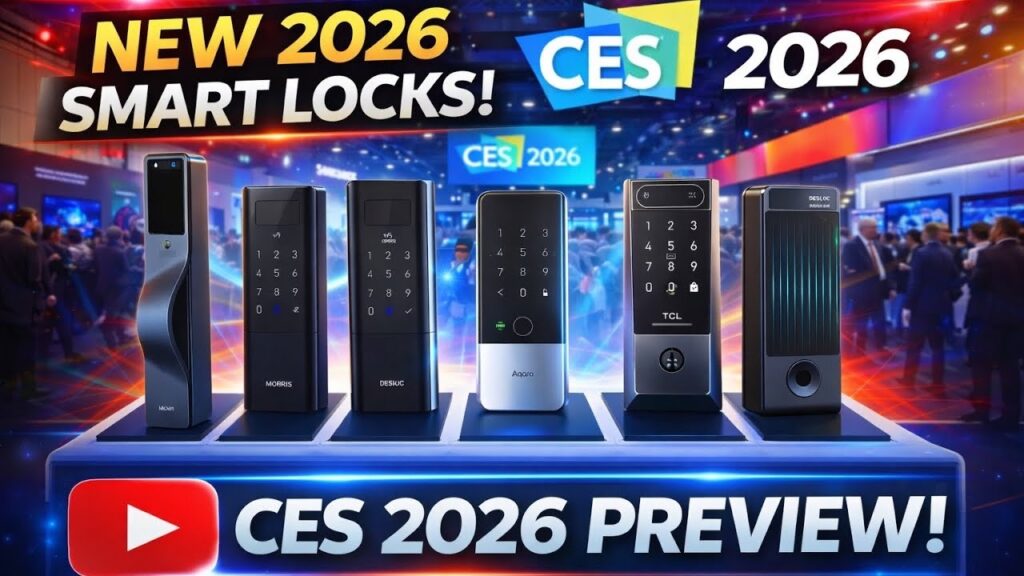
At CES 2026, you’ll witness the biggest leap in smart lock technology yet, and Silver Eagle Locksmith’s video breaks down the most innovative models and features. You’ll see demos of biometric fingerprint and facial recognition, AI-driven access control, app-based remote access, and smooth integration with Google Home, Alexa, and Apple Home.
The video highlights flagship models like the SwitchBot Lock Ultra Vision, Lockin V7 Max, ULTRALOQ bolt Sense, Aqara U400, Kwikset Aura Reach, and DESLOC V150 Plus while comparing residential and commercial security advances. Whether you’re a homeowner, real estate investor, Airbnb host, or security professional, you’ll learn which smart locks could change how you protect your property, and you’ll want to watch till the end to see which technology stands out for 2026.
CES 2026 Smart Locks Overview
CES 2026 delivered a concentrated showcase of smart lock advances that directly affect how you secure homes and businesses. The event highlighted not just incremental updates but a new generation of devices pairing stronger physical hardware with smarter software, making everyday access more convenient while aiming to raise the bar on security and interoperability.
Synopsis of major smart lock reveals and demonstrations at CES 2026
At CES you saw a mix of refined designs and bold prototypes: biometric models with combined fingerprint and facial recognition, AI-aware controllers that learn behavior, camera-assisted entry locks, and several products emphasizing Matter and major ecosystem support. Demonstrations focused on real-world reliability, anti-spoofing measures, and smoother guest workflows — all signals that these technologies are moving from novelty to mainstream.
Key innovation themes: biometrics, AI-driven access, app control, ecosystem integration
Four clear themes dominated the show: multispectral biometrics for faster, more reliable verification; AI that adapts access decisions and threat detection; more usable and secure mobile apps for onboarding and guest management; and deeper integration with ecosystems like Google, Amazon, and Apple through standards such as Matter. Those themes together point toward locks that are both smarter and easier for you to manage.
Why CES 2026 represents a leap for residential and commercial door security
CES 2026 represented a leap because manufacturers converged on practical, deployable solutions rather than concept demos. You’ll find improved sensor stacks, on-device ML, robust anti-spoofing, and enterprise-grade audit capabilities packaged into products ready for homes, rentals, and workplaces. That maturation means earlier adopters can benefit now, while professionals can plan secure rollouts with clearer roadmaps.
Breakthrough Technologies Revealed
The breakthroughs shown at CES combined hardware and software improvements that address previous limitations: false accepts, poor weather tolerance, battery life, and ecosystem fragmentation. You’ll notice these are no longer separate upgrades but a coordinated approach where sensors, AI, connectivity, and physical design work together to deliver a trustworthy access experience.
Advanced sensor fusion combining fingerprint, facial recognition, and proximity
Sensor fusion was a big theme: locks now combine capacitive fingerprint sensors, infrared and RGB facial cameras, and BLE/UWB proximity signals to make access decisions. By fusing these inputs you’ll see faster, more accurate authentication with fewer false positives, and the ability to adapt which factors are required depending on context — for example requiring a face scan if proximity is ambiguous.
AI-driven access control systems that adapt to user behavior and threat signals
AI-driven systems are learning typical entry patterns for residents and flagging anomalies like unusual hours or unknown devices. These systems adapt over time so you’ll get fewer nuisance locks and smarter challenge prompts when something looks risky. For enterprises, adaptive risk scoring can enforce stricter checks during suspicious events without disrupting normal occupants.
Improved liveness detection and anti-spoofing measures
Liveness detection moved from rudimentary checks to multi-factor anti-spoofing: depth mapping, micro-movement analysis, heartbeat signals from capacitive scans, and challenge-response prompts when confidence is low. That means you’ll be much less vulnerable to photos, masks, or fabricated fingerprints, and locks can escalate verification only when necessary to preserve convenience.
New communication layers for lower-latency and more secure lock interactions
Communication got an upgrade with low-latency channels like UWB for proximity and improved BLE 5.x implementations for stable local control, plus Matter framing for standardized messaging. These layers reduce lag for approach-based features and support encrypted exchanges that limit exposure to replay or interception attacks, so you’ll experience faster, safer responses from your locks.
Notable Smart Lock Models at CES 2026
CES featured a mix of well-known brands and newcomers, each pushing different tradeoffs between biometrics, cameras, enterprise features, and price. Below are the locks getting the most attention and what they mean for you depending on your use case.
Lockin V7 Max: standout features and target use cases
The Lockin V7 Max impressed with a multimodal approach—high-resolution fingerprint scanner, infrared face camera, and robust physical build. It targets both tech-savvy homeowners who want fast biometric entry and small offices that need reliable audit logs. You’ll benefit from its balance of speed, security, and a polished mobile app for guest management.
SwitchBot Lock Ultra Vision: camera-assisted entry and vision-based auth
SwitchBot’s Ultra Vision model leaned into camera-assisted entry with on-device vision models that authenticate users and capture short approach clips for context. It’s ideal if you value visual verification and want seamless integration into a broader SwitchBot ecosystem. You’ll like the convenience, but should weigh camera-centric privacy and storage choices.
ULTRALOQ bolt Sense: durability, multi-auth modes, and enterprise features
ULTRALOQ’s bolt Sense focused on ruggedness and enterprise readiness: reinforced bolt hardware, multiple credential modes, and more detailed access control policies. It’s a good fit if you manage multi-user facilities or rental properties and need durable hardware plus scalable admin tools. You’ll appreciate its lifecycle management and audit capabilities.
TCL D2 Pro and Aqara U400: value propositions and integration strengths
TCL’s D2 Pro and Aqara’s U400 aimed at the value-conscious user while offering solid integration. TCL emphasized affordability with reliable mechanics and cloud options, while Aqara prioritized seamless Apple Home and Matter functionality for smart home enthusiasts. If you want a lock that plays well with existing hubs and devices without breaking the bank, these models deserve attention.
Kwikset Aura Reach Matter & Bluetooth model: Matter compatibility and backward support
Kwikset showcased a Matter-capable Aura Reach alongside a Bluetooth-focused variant, illustrating a transition strategy that supports both modern and legacy setups. You’ll gain cross-vendor compatibility with the Matter version and retain simple Bluetooth fallback for areas where mesh or internet connectivity is limited, giving you flexible deployment options.
DESLOC V150 plus: commercial-grade credentials and audit trail highlights
The DESLOC V150 plus presented itself as a commercial-grade solution with strong credential management, support for RFID and mobile credentials, and comprehensive audit trails. It’s suited for property managers and businesses that need compliance-ready logs and role-based access policies. You’ll find its focus on accountability and integration with building systems especially useful.
App-Based Security and Remote Access
Apps remain the primary interface for setup, access, and administration, and CES devices showed meaningful improvements in usability and security. You’ll find fewer friction points during onboarding and richer tools for monitoring, delegating access, and diagnosing lock health remotely.
Modern app UX improvements for onboarding, guest management, and diagnostics
App UX improvements at CES emphasized step-by-step setup wizards, clearer permission flows, and visual onboarding for credential enrollment. Guest management now supports templates and expiry rules so you can create recurring or temporary access with a few taps. Diagnostics surfaced battery health, signal strength, and recent events in a readable format so you can troubleshoot without specialized tools.
Remote access models: cloud-hosted control, local LAN fallback, and hybrid approaches
Manufacturers presented three remote access models: cloud-hosted for easy everywhere control, local LAN fallback for privacy and reliability, and hybrid systems that combine both. You’ll need to decide whether you prefer convenience (cloud) or resilience and reduced third-party exposure (local/hybrid). Hybrid approaches offer the most flexibility, letting you keep remote features while preserving local control when needed.
Temporary access and scheduled/one-time codes for guests and service providers
Newer apps streamline issuing scheduled or one-time codes, QR passes, and geofenced unlocks for delivery or service personnel. You’ll be able to set narrow windows, automatic expiry, and activity notifications to make short-term access safe and auditable. These workflows especially benefit rentals, cleaners, and maintenance staff, reducing key handoffs and confusion.
Security concerns around app platforms, multi-factor options, and notification handling
Despite UX gains, app security remains a concern: weak account protection, notification overexposure, and cloud misconfigurations can expose access. CES demos showed improved multi-factor authentication, device-bound credentials, and better notification privacy settings so you get alerts without leaking sensitive details. You should enable MFA, review permissions, and choose notification verbosity to match your security needs.
Smart Home Integration and Interoperability
Interoperability is moving from “nice to have” to a core requirement as people expect locks to participate in scenes and routines. CES 2026 reaffirmed that when locks truly speak the same language as lights, cameras, and thermostats, your home automation becomes more cohesive and useful.
Matter adoption and what it means for cross-vendor compatibility
Matter adoption was a headline takeaway: locks supporting Matter will be easier to control from different ecosystems without vendor-specific bridges. For you, that means buying a lock with Matter support helps future-proof purchases — it’s more likely your new lock will work with smart home platforms you adopt down the road without proprietary silos.
Native integrations with Google Home, Alexa, and Apple Home ecosystems
Many locks at CES showed native integrations with Google Home, Alexa, and Apple Home, letting you use voice, routines, and centralized scenes. You’ll enjoy convenience, such as voice-initiated lock checks and automations tied to presence, but should balance voice control against the risk of accidental commands and ensure you configure voice security settings.
Scene and routine integration: locks working with lighting, cameras, and HVAC
Locks are becoming scene-aware: unlocking can trigger lights, disarm cameras, or set HVAC to a preferred mode, and conversely a security alarm event can lock doors automatically. You’ll gain smoother daily experiences and energy savings, but should design routines with fail-safes so one device’s error doesn’t cascade into missed access or safety issues.
Cross-device continuity: maintaining access rules across hubs and bridges
Cross-device continuity at CES focused on keeping access rules consistent across hubs and bridges so credentials and schedules don’t diverge when you swap hardware. For you, that reduces management overhead and prevents orphaned permissions. Look for locks that export/import settings or sync policies via cloud profiles to simplify upgrades and migrations.
AI and Machine Learning in Access Control
AI and ML are shifting from backend analytics to real-time decisioning at the edge, providing both convenience and smarter security. CES devices demonstrated how learning models can reduce friction while adding adaptive protections against evolving threats.
Behavioral analytics for anomaly detection and adaptive risk scoring
Behavioral analytics can detect deviations from normal entry patterns and assign risk scores that influence authentication requirements. You’ll benefit from systems that alert you about suspicious activity and that escalate checks only when the score warrants it, keeping day-to-day access fast while improving response to potential breaches.
Edge AI vs cloud AI tradeoffs: latency, privacy, and updateability
Edge AI offers low latency and better privacy because models run on-device; cloud AI enables heavier analytics and faster updates. You’ll need to weigh immediate responsiveness and data minimization against richer insights and easier model rollout. Best systems offer a hybrid model, running core inference locally and optionally submitting anonymized telemetry for cloud analytics if you opt in.
Predictive automations like pre-unlocking based on approach patterns
Predictive automations now let locks pre-unlock when they detect you approaching based on proximity, motion, and historical timing. That convenience is compelling — you’ll walk up and the door can be ready — but it should be configurable, with clear thresholds and fail-safes to avoid unintended entry for nearby non-residents.
Safeguards to prevent AI-driven false authorizations and adversarial exploits
Manufacturers showcased safeguards like multi-signal consensus, confidence thresholds, forced challenge prompts, and adversarial testing to prevent false positives. You should favor systems that require corroborating signals (e.g., proximity plus biometric) and that expose audit trails so you can review and correct any anomalous authorizations.
Biometric Authentication Advances
Biometrics matured significantly at CES, with attention on multimodal approaches, on-device ML to speed recognition, and liveness measures that make spoofing far more difficult. These improvements make biometrics a practical primary or secondary authentication method for many users.
Multi-modal biometrics that combine fingerprint, facial, and voice signals
Combining fingerprint, facial, and even voice inputs increases accuracy and redundancy. For you, multi-modal biometrics mean fewer lockouts and flexible authentication choices — for instance, fingerprint for quick solo returns and face or phone proximity for hands-full entry. Modes can be prioritized or combined depending on your security posture.
Speed and accuracy gains from next-gen sensors and on-device ML
Next-gen sensors and optimized on-device ML reduced false rejects and recognition time. You’ll notice faster unlocks and fewer retries, especially in challenging lighting or with wet fingers. On-device processing also keeps biometric templates local, which is important for privacy-conscious users.
Liveness detection and anti-spoofing tactics to counter photos, masks, and molds
New liveness techniques used depth sensing, subtle motion detection, and material-response checks to defeat spoofing attempts. This layered approach means that simple presentation attacks (photos, printed masks, silicone molds) are much less likely to succeed, improving trust in biometrics as a reliable access method for your home or business.
Accessibility considerations for children, elderly, and users with disabilities
Designers showed more inclusive approaches: fallback credential methods, adjustable biometric sensitivity, and administrative ways to enroll users who can’t reliably present a fingerprint or face. You should plan for alternative credentials and caregiver access, ensuring that increased security doesn’t inadvertently lock out people who need simpler options.
Physical Security and Hardware Improvements
While software got smarter, hardware improvements addressed the physical realities of forced entry, weather, and power constraints. The best CES designs married secure mechanisms with thoughtful durability features so your investment resists tampering and the elements.
Reinforced deadbolts, tamper sensors, and attack-resistant chassis designs
Locks at CES offered thicker bolting, anti-drill plates, and tamper sensors that detect prying or sudden impacts. Tamper events can trigger local alarms, camera recordings, and admin notifications so you’ll get immediate context and evidence. Prioritize locks with proven mechanical resistance if forced entry is a concern for your property.
Battery lifespan improvements, low-power modes, and emergency power options
Better power management extended typical battery life and added low-power sleep states for sensors. Many locks now provide emergency power contacts or fast-charge options so you can recover access during unexpected drain. You’ll want to check realistic battery-life claims and look for courteous low-battery notifications and accessible emergency override methods.
Weatherproofing, ingress protection ratings, and durability for exterior use
Manufacturers improved seals, coatings, and materials to meet higher IP ratings and withstand temperature swings. If you install locks outdoors or in exposed locations, seek models with tested ingress protection and materials rated for UV and corrosion resistance so your lock continues to perform across seasons.
Certification and independent security ratings (e.g., BHMA, UL) and what to look for
Independent certifications like BHMA and UL give you objective assurance about mechanical strength and electronic resilience. Look for locks with industry-standard ratings and public test results; certifications help you compare claims and ensure the device meets thresholds for forced entry resistance and electronic reliability you can trust.
Residential and Commercial Use Cases
CES 2026 showcased solutions tailored to different needs: homeowner convenience, short-term rentals, property management scale, and commercial compliance. Knowing how each scenario maps to features will help you choose the right lock and manage it effectively.
Homeowner scenarios: family profiles, shared access, and activity logs
For families, smart locks now support individual profiles, personalized notifications, and simple shared access. You’ll be able to track who came and when, set child-specific schedules, and automatically adjust access for caregivers. These features improve peace of mind without sacrificing everyday convenience.
Airbnb and short-term rental workflows: keyless check-in, temporary codes, and automation
Hosts gained better one-time code flows, automated check-in sequences, and integrations with booking platforms to streamline guest turnover. You’ll reduce lockouts and key exchanges, automate check-in instructions, and restrict access outside reservation windows — useful tools to scale hospitality operations without adding administrative burden.
Property management and multi-unit solutions: scalable credentialing and remote administration
Property managers saw improvements in centralized credential provisioning, bulk enrollment, and role-based admin tools that simplify managing many units. You’ll benefit from batch provisioning, remote firmware management, and consolidated audit logs, which reduce on-site visits and improve operational control across portfolios.
Commercial access control: audit trails, credential lifecycle, and integration with enterprise systems
Commercial deployments emphasized audit-grade logging, credential lifecycle management, and integrations with identity and building management systems. If you’re securing offices or multi-tenant buildings, these features support compliance, simplify revocations, and let you integrate door events into security operations workflows and incident response.
Conclusion
CES 2026 made it clear that smart locks are entering a more mature phase where biometrics, AI, reliable hardware, and open ecosystems converge to deliver real-world benefits. You’ll find choices that match casual home use to enterprise needs, and a clearer path for future-proofing through standardization and robust security practices.
Recap of CES 2026’s most impactful smart lock advancements
The most impactful advances were multimodal biometrics, adaptive AI access controls, stronger anti-spoofing, Matter and ecosystem interoperability, and practical hardware improvements like reinforced bolts and better battery strategies. These combined changes deliver both convenience and a measurable increase in security for various deployment types.
Practical takeaways for homeowners, Airbnb hosts, and security professionals
Homeowners should prioritize Matter support, robust app security, and mechanical certifications. Airbnb hosts should focus on reliable temporary access and automation. Security professionals need to evaluate audit capabilities, credential management workflows, and integration with enterprise systems. In every case, enable MFA, test fail-safes, and verify backup entry options.
How to evaluate which new technologies matter now versus those to watch for future adoption
Focus now on proven upgrades: strong mechanical design, reliable biometrics with liveness detection, and interoperability (Matter) for future flexibility. Watch emerging features like advanced AI risk scoring, UWB-based passive entry, and richer on-device behavioral analytics as they mature and receive independent validation. Choose a solution that balances your current needs with a clear upgrade path so your investment remains useful as the ecosystem evolves.
CES 2026 Smart Locks – The Future of Home Security Is Here. In this video, you’ll get a clear breakdown of the most innovative smart locks revealed at CES 2026, including biometric locks, AI-powered access control, app-based security, and next-generation smart home integration.
If you care about home security, smart locks, or the future of smart homes, this video gives you everything you need to know about what’s coming next.
Disclosure:
As an SwitchBot Associate I earn from qualifying purchases if you use this link, but there is no additional cost to you. 
✅ SwitchBot Lock Ultra Vision Pro + 💲Get 25% Off with Cupon code: MKMK25
🔐 Featured Smart Lock Innovations at CES 2026:
• Advanced fingerprint \u0026 facial recognition locks
• AI-driven access control systems
• App-controlled smart locks with remote access
• Integration with Google Home, Alexa \u0026 Apple Home
• High-security residential \u0026 commercial smart locks
Whether you’re a homeowner, real estate investor, Airbnb host, or security professional, these new smart locks could completely change how you protect your homes and businesses.
📌 Watch till the end to see which smart lock technology stands out the most in 2026.
👍 If you found this helpful, like the video
📲 Subscribe for more smart lock \u0026 home security tech
💬 Comment below: Which smart lock would you trust on your front door?
CES 2026 smart locks, new smart locks 2026, CES smart home, smart lock technology, biometric door locks, AI smart locks, home security CES, best smart locks 2026, digital door locks, smart home security, CES tech review
Disclaimer: This video is intended as a general guide. Always refer to your lock’s specific model instructions for precise steps and safety information.
Main website: https://silvereaglelocksmith.com
Henderson Website – http://www.silvereaglelocksmithhender…
Facebook – / silvereaglelocksmithlv
Yelp – http://www.yelp.com/biz/silver-eagle-…
Twitter- / silvereaglekey
Instagram – / locksmith_las_vegas
BBB: https://www.bbb.org/us/nv/las-vegas/p…
